


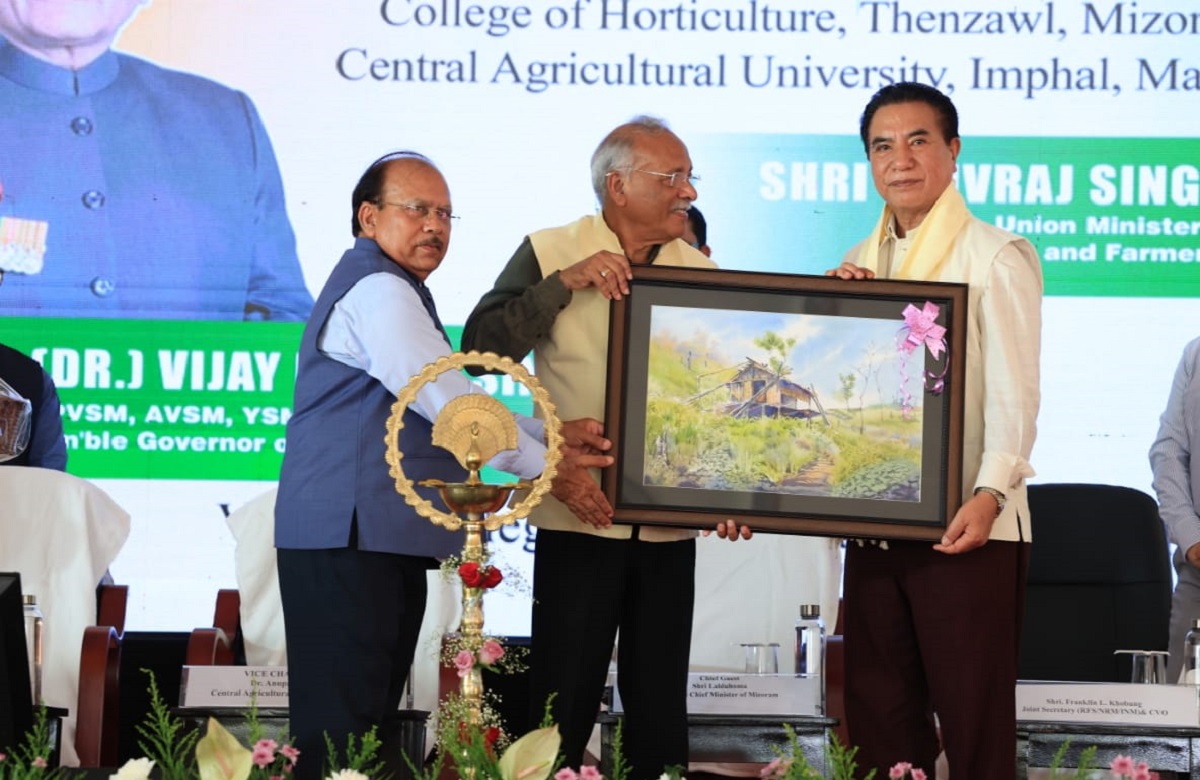
Union Minister for Agriculture and Farmers Welfare Shivraj Singh Chauhan on Thursday said agricultural system of Mizoram is deeply intertwined with the tribal lifestyle of its people.
Chauhan, who inaugurated the administrative-cum-academic building of the College of Horticulture through video conferencing said the major horticultural crops of the state—such as passion fruit, mandarin orange, banana, mango, pineapple, dragon fruit, cabbage, tomato, brinjal, chow-chow, ginger, turmeric, and chili—are well-suited to its climate and ecological conditions.
He, however, lamented that though the state receives abundant rainfall, only 4.5% of its cultivable land is currently being utilised, much of which lies in hilly and sloping terrains.
“Additionally, oil palm cultivation is emerging as an innovative agricultural activity in the state. In the year 2021–22, agriculture and allied sectors contributed Rs. 6,13,716 lakh to the state’s Gross Domestic Product, reflecting the central role of agriculture in Mizoram’s economy,” he said.
The union minister emphasised that Mizoram has numerous niche areas, making it a state with special agricultural potential including organic farming with a tradition of chemical-free agriculture, the production of organic spices such as ginger, turmeric, and chili has immense potential. He also said that the climate is highly suitable for cultivation of passion fruit which can become a signature product of Mizoram while high-value aromatic and medicinal plants like stevia, ashwagandha, tulsi, and advanced varieties of ginger and turmeric.
He also underscored the importance of bamboo-based agricultural systems as sustainable use of natural resources can support agriculture, construction, handicrafts, and bio-energy. Honey bee-keeping and bio-honey production, owing to the rich floral diversity can create a great scope for high-quality honey production as well as floriculture with flowers such as orchids, gladiolus, marigold, and roses, with potential for international market linkage. He also stated that fishery and duck rearing using reservoirs and lakes offer great opportunities for integrated agricultural models .
He said the state is emerging as a major centre for the cultivation of ginger, Mizo chili, and turmeric, with around 75,081 acres under cultivation with farmers benefitting from the shift toward oil palm cultivation, supported by the Government of India. The total area under oil palm cultivation stands at 26,730 hectares, involving approximately 10,843 families.
“However, alongside these opportunities, there are several challenges—such as farming on sloped lands, limited irrigation facilities, soil erosion, and traditional jhum (shifting) cultivation practices. The total geographical area of the state is 2,108 thousand hectares, but the net sown area is only 95 thousand hectares, and the irrigated area is a mere 19 thousand hectares,” he said.
State Chief Minister Lalduhoma who also spoke at the inaugural function said the College of Horticulture, Thenzawl, since its inception in 2016, has grown into a centre of excellence.
Lalduhoma said that set in the heart of one of Mizoram’s most picturesque and culturally rich towns, the college offers a dynamic learning environment that blends academic rigour with real-world relevance. With its flagship B.Sc. (Hons.) in Horticulture programme aligned with the 5th Dean Committee recommendations of ICAR, the college is laying a strong foundation for nurturing skilled professionals and future leaders in this vital field.


+ There are no comments
Add yours